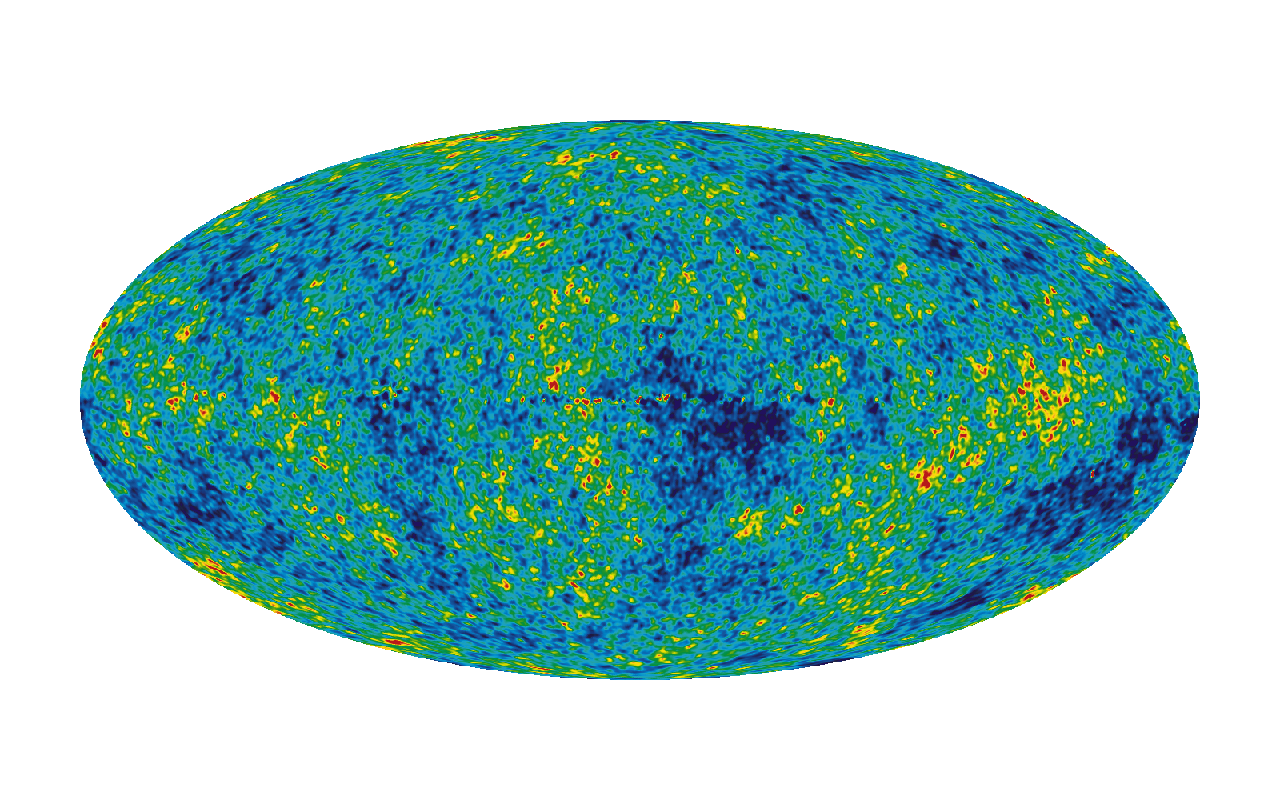
 Photo credit: NASA WMAP
We can classify cosmic radiation based on its source: the sun, stars, and accretion discs of black holes. Cosmic radiation can be electromagnetic waves or high-energy particles[3] (electrons and protons). Since cosmic radiation includes all bands found in the Electromagnetic Spectrum, it's important to know that much of the high-energy radiation is absorbed by Earth's atmosphere. Some ultraviolet light emitted by the Sun, that is not absorbed can reach Earth's surface. The near ultraviolet radiation has a frequency range of 1 PHz to 3 PHz, corresponding to a wavelength of 300 nm to 100 nm. These rays are harmful to humans because they cause skin cancer, so people should wear sunscreen. The UV rays interact with matter by modifying molecules and causing chemical changes.
The most important part of cosmic radiation is the sunlight. The sunlight has a profound effect on life on Earth. The visible light's (visible to humans) frequency range is 790 THz to 400 THz, while the wavelength ranges from 380 nm to 760 nm. Visible light provides energy for plants to do photosynthesis and be able to grow. It also can be utilized to create clean energy using solar panels.
 Photo credit: OKsolar.com
High-energy electromagnetic radiation (X-ray and gamma-ray) are absorbed by the atmosphere, but they present danger to astronauts. The frequency range of X-ray is 30 PHz to 30,000 PHz, and the wavelength is 10 nm to 1 pm. The frequency range of Gamma-rays start at 30,000 PHz and there is no end. Therefore any Electromagnetic wave with a wavelength less than 1 pm is a Gamma-ray.
Electromagnetic waves of the cosmic radiation are discussed above. However, there are particles that also make up cosmic radiation that were not researched. Due to the multitude of Electromagnetic wave sources that produce cosmic radiation, the frequency and wavelengths cover a very wide range. Some sources like CMB are continuous, with very little change in their power density. Others, like Gamma-ray bursts are highly transcient. There are several month-long gaps separating a few seconds of high-energy bursts. This is why generic properties of the EM spectrum cannot be specified for the entire cosmic radiation, only different parts of it (like CMB).
References:
1. G. F. Smoot and D. Scott, http://pdg.lbl.gov/2000/microwaverppbook.pdf, 19. Cosmic Background Radiation
2. Dr. Seti, http://www.setileague.org/askdr/backgrnd.htm, Frequency of the Cosmic Background
3. Brent Nelson, M.A. Physics, Ph.D. Student, UC Berkeley, http://www.physlink.com/Education/AskExperts/ae254.cfm?CFID=27071600&CFTOKEN=7ada1b628d936e8d-9CD1BC03-15C5-EE01-B9386A09AF12FF96, What is cosmic radiation? Is it dangerous?


No comments:
Post a Comment