Tuesday, March 30, 2010

UV Rays Increase Intelligence

Who would have thought that UV rays may increase proficiency in school exams? What are UV rays anyway? UV stands for Ultraviolet light, which is an invisible light wave to humans, but can be seen by some insects such as the bumblebee. Ultraviolet light is part of the Electromagnetic Spectrum. You have already come into contact with this light wave.

UV rays are emitted from the sun and stars as part of cosmic radiation. Scientists like to study UV rays because it helpts to learn more about Cosmos. Some of the Ultraviolet rays are absorbed by the Earth's atmosphere, however many of them still make it through. UV rays travel at the speed of light, as do any other parts of the EM Spectrum. The frequencies[1] of UV rays range from 7.5×10^14 to 3×10^17 Hz, while the wavelength ranges from 4×10^−5 to 10^−7 cm. There are three regions of ultraviolet light: near (closest to visible light), far (most unknown), and extreme (closest to X-ray). The three regions have "different energies of ultraviolet radiation"[2]. The energy ranges from 3 to 10^3 eV, which makes it more energetic than visible light, and allows it to create more harm.

The effect of UV rays can be seen when every year people come back from vacations with a full-blown sunburn. The energy of the UV light allows it to break up molecules when absorbed by the skin. Also, it can penetrate deeper than visible light, which makes the damage more serious. If the UV rays damage the DNA of a skin cell, then it has the potential to cause melanoma[3], a very dangerous form of skin cancer, so people must wear sunscreen.

The same ability to break up molecules allows UV rays to not only harm, but to help with sanitation purposes. Water Coolers and Dispensers you can find in offices contain a UV sanitation filter system. This idea gives the basis for SODIS, a Swiss-water disinfection program used in many third world countries to provide water safe to drink[4]. In Tanzania, Ndolela Primary School has been using SODIS since 2006. They experienced fewer cases of diarrhea, which increased attendance at the school. In return, the percentage of students passing the 6th Grade Exam increased from 15% to 95%. This is how UV rays helped with proficiencies at this school.


Photo Credit: NASA
National Cancer Institute

References:
1. Eberhard Sengpiel, Sengpielaudio Search Engine, Calculator - Wavelengths, 2. Radio waves and Light waves in a vacuum

2. Ruth Netting, NASA, The Electromagnetic Spectrum

3. National Cancer Institute, Melanoma

4. Mark Jenkins, National Geographic Water April 2010 Issue, Energy

Friday, March 26, 2010

Messengers from the Cosmos: Cosmic Radiation

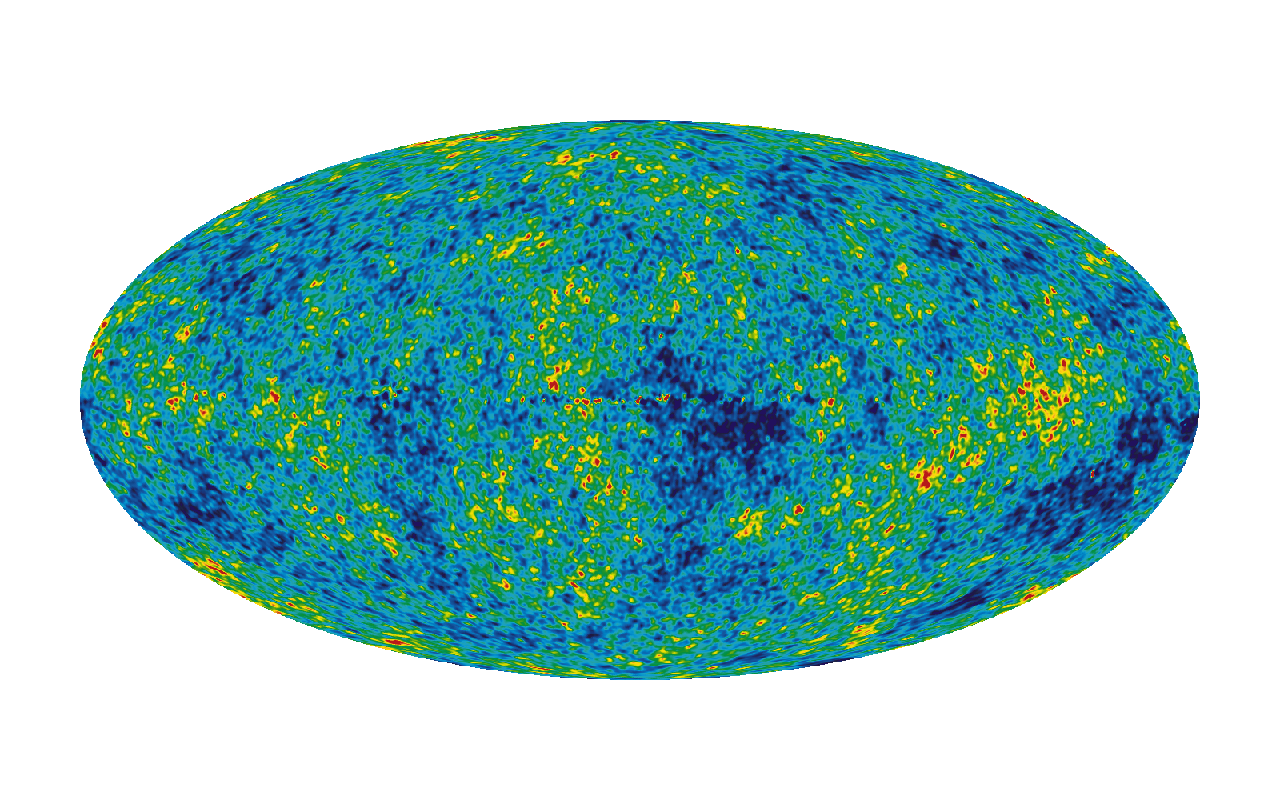
Cosmic radiation is many different types of radiation from many different sources coming from cosmic objects. However, when most people speak of 'cosmic radiation' they are referring to cosmic background radiation, which is an electromagnetic radiation that originates from about 200,000 years after the big bang. The cosmic background radiation[1] (CMB) is detected as a black body radiation[2] of 2.7 Kelvins. Therefore, CMB covers a wide spectrum of frequencies and wavelengths. The maximum amplitude corresponds to a wavelength of 2 mm and a frequency of 150 GHz. The CMB is absorbed by conductive materials, and creates heat, just like a microwave does, except it's much weaker. CMB has very low energy, so it does not present any hazards to humans. An interesting fact about CMB is how uniform it is from all directions. Satelites that measure CMB, detect changes of 0.01% in CMB's intensity, in order to create cosmic background radiation maps.

Photo credit: NASA WMAP

We can classify cosmic radiation based on its source: the sun, stars, and accretion discs of black holes. Cosmic radiation can be electromagnetic waves or high-energy particles[3] (electrons and protons). Since cosmic radiation includes all bands found in the Electromagnetic Spectrum, it's important to know that much of the high-energy radiation is absorbed by Earth's atmosphere. Some ultraviolet light emitted by the Sun, that is not absorbed can reach Earth's surface. The near ultraviolet radiation has a frequency range of 1 PHz to 3 PHz, corresponding to a wavelength of 300 nm to 100 nm. These rays are harmful to humans because they cause skin cancer, so people should wear sunscreen. The UV rays interact with matter by modifying molecules and causing chemical changes.

The most important part of cosmic radiation is the sunlight. The sunlight has a profound effect on life on Earth. The visible light's (visible to humans) frequency range is 790 THz to 400 THz, while the wavelength ranges from 380 nm to 760 nm. Visible light provides energy for plants to do photosynthesis and be able to grow. It also can be utilized to create clean energy using solar panels.

Photo credit: OKsolar.com

High-energy electromagnetic radiation (X-ray and gamma-ray) are absorbed by the atmosphere, but they present danger to astronauts. The frequency range of X-ray is 30 PHz to 30,000 PHz, and the wavelength is 10 nm to 1 pm. The frequency range of Gamma-rays start at 30,000 PHz and there is no end. Therefore any Electromagnetic wave with a wavelength less than 1 pm is a Gamma-ray.

Electromagnetic waves of the cosmic radiation are discussed above. However, there are particles that also make up cosmic radiation that were not researched. Due to the multitude of Electromagnetic wave sources that produce cosmic radiation, the frequency and wavelengths cover a very wide range. Some sources like CMB are continuous, with very little change in their power density. Others, like Gamma-ray bursts are highly transcient. There are several month-long gaps separating a few seconds of high-energy bursts. This is why generic properties of the EM spectrum cannot be specified for the entire cosmic radiation, only different parts of it (like CMB).


References:
1. G. F. Smoot and D. Scott, http://pdg.lbl.gov/2000/microwaverppbook.pdf, 19. Cosmic Background Radiation

2. Dr. Seti, http://www.setileague.org/askdr/backgrnd.htm, Frequency of the Cosmic Background

3. Brent Nelson, M.A. Physics, Ph.D. Student, UC Berkeley, http://www.physlink.com/Education/AskExperts/ae254.cfm?CFID=27071600&CFTOKEN=7ada1b628d936e8d-9CD1BC03-15C5-EE01-B9386A09AF12FF96, What is cosmic radiation? Is it dangerous?